Understanding the Korean Age System
If you have ever interacted with Korean culture—whether through K-dramas, K-pop, or travel—you may have noticed that Koreans often seem one or two years older than what their international age would suggest. This is not a mistake. Korea has a traditional age system that works differently from the standard international method. Understanding how to calculate Korean age is essential for anyone engaging with Korean culture, business, or social settings.
What Is Korean Age?
Korean age is a traditional method of counting age that makes everyone 1 year old at birth, and then everyone’s age increases by one on New Year’s Day (January 1st), not on their actual birthday. This means two people born in the same year are the same Korean age, regardless of whether they were born in January or December.
For example, a baby born on December 31st is considered 1 year old on the day of birth. The very next day—January 1st—they turn 2 in Korean age. Meanwhile, the same baby would be 0 years old in international age (or just a few hours old).
The Korean Age Formula
The basic formula for calculating Korean age is simple:
Korean Age = Current Year − Birth Year + 1
If you were born in 1990 and the current year is 2025:
Korean Age = 2025 − 1990 + 1 = 36
There is one subtlety: if your birthday has already passed this year, your international age and Korean age differ by only 1 year. If your birthday has not passed yet, they differ by 2 years. The “+1” in the formula accounts for the fact that you are already considered 1 at birth.
Korean Age vs. International Age: Key Differences
| Aspect | Korean Age | International Age |
|---|---|---|
| Age at birth | 1 year old | 0 years old |
| Aging date | January 1st (everyone) | Birthday (individual) |
| Same birth year | Same age regardless of birth month | Different ages if born in different months |
| Common usage | Traditional, social contexts | Official, legal, medical documents |
Cultural Context: Why Does Korea Use This System?
The Korean age system has deep cultural roots. In traditional East Asian culture, the time spent in the womb was counted as part of a person’s life—hence being 1 at birth. The New Year’s Day aging comes from the lunar calendar and the collective celebration of a new beginning for everyone.
Although South Korea officially adopted the international age system for legal and medical purposes in 2023, Korean age is still widely used in social contexts. It matters for:
- Social hierarchy: Age determines honorifics, speech levels, and social dynamics. Knowing someone’s Korean age tells you how to address them respectfully.
- Alcohol and tobacco: While legal age is 19 in international years, social conversations about age still use the Korean system.
- School enrollment: Children born in the same year enter school together, reinforcing the collective age concept.
- Festivals and traditions: On New Year’s Day (Seollal), everyone turns one year older together.
Real-World Example
Let’s say someone was born on June 15, 2000. If today is March 10, 2025, here’s the breakdown:
• International age: 24 (birthday has not passed yet)
• Korean age: 2025 − 2000 + 1 = 26
Once their birthday passes on June 15, 2025, their international age becomes 25, while Korean age stays 26 (until New Year’s Day 2026, when it becomes 27).
How to Calculate Korean Age Quickly
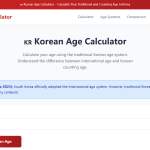
Instead of doing the math manually every time, you can use the Korean Age Calculator on YouAgeCalculator.com. Simply enter your birth date, and the tool instantly shows your Korean age alongside your international age. It’s perfect for travelers, K-culture enthusiasts, or anyone who needs quick conversions without confusion.
Final Thoughts
The Korean age system is a fascinating reflection of East Asian cultural values—emphasizing collective milestones over individual ones. While it may seem unusual at first, understanding it is key to navigating Korean social life, business etiquette, and cultural content. Whether you are planning a trip to Seoul, working with Korean colleagues, or just curious about age traditions around the world, knowing how to calculate Korean age is a small but meaningful step.
Try the Korean Age Calculator now to see your own Korean age!