If you have ever interacted with Korean friends, watched a K-drama, or applied for something in South Korea, you have probably noticed that Koreans often say they are one to two years older than their international age. This is not a mistake — Korea has its own unique age calculation system that differs from the standard international method. Understanding how Korean age works is essential for anyone doing business in Korea, applying for Korean visas, or simply curious about cultural differences.
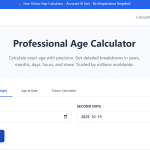
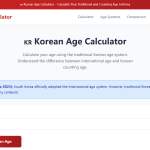
You can calculate your Korean age instantly using our Korean Age Calculator — it handles the math for you in seconds.
How Korean Age Works
Korean age counts the time you spend in the womb as your first year of life. Everyone is considered 1 year old at birth. Then, instead of adding a year on your birthday, everyone in Korea turns one year older on New Year’s Day (January 1st). This means:
- A baby born on December 31st is 1 year old on that day… and turns 2 on January 1st (the next day).
- A baby born on January 1st is 1 year old at birth, and turns 2 on the following January 1st.
Under this system, your Korean age can be 1 or 2 years more than your international age, depending on whether your birthday has passed in the current calendar year.
Korean Age vs International Age: Quick Comparison
| Scenario | International Age | Korean Age |
|---|---|---|
| Born June 15, 2000 (before birthday in 2026) | 25 | 27 |
| Born June 15, 2000 (after birthday in 2026) | 26 | 27 |
| Born December 31, 2025 | 0 | 2 |
The Formula
The simple formula for Korean age is:
Korean Age = Current Year – Birth Year + 1
For example, if you were born in 1995 and the current year is 2026:
2026 – 1995 + 1 = 32 years old in Korean age
This formula works regardless of whether your birthday has passed. That is why Koreans born in the same year are considered the same age — your birth month and day do not matter under this system.
Why Does Korean Age Exist?
The Korean age system has deep cultural roots. In East Asian tradition, the time spent in the womb was considered part of a person’s life, so a newborn was already counted as one year old. The January 1st increment comes from the lunar calendar influence and the collectivist idea that people born in the same year share the same age cohort.
In 2023, South Korea passed a law to standardize international age for legal and medical documents, but Korean age is still widely used in social settings — especially for determining honorifics, drinking age, and school year placement.
When Each System Is Used
- Korean Age — Social settings, asking someone’s age, drinking alcohol (19 in Korean age), school year grouping
- International Age — Legal documents, passports, medical records, contracts, airline tickets
- Year Age (뇌 나이) — Used for military conscription eligibility, school enrollment cutoff
Try our Korean Age Calculator to instantly convert your birth date into all three age systems.
Common Mistakes to Avoid
- Don’t add 1 or 2 to your international age randomly — use the formula above based on the current year
- Don’t assume your birthday matters — for Korean age, only the birth year and current year matter, not the month/day
- Don’t use Korean age on official forms — South Korea now uses international age for all legal and administrative purposes
For the full conversion breakdown and a handy reference tool, check out our Korean Age Calculator page.