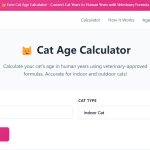
If you have ever wondered how old your pet really is in human years, you are not alone. The old rule of “one dog year equals seven human years” is a simplification that does not reflect how different species and breeds age. Our Pet Age Calculator gives you a much more accurate estimate based on the latest veterinary research.
How Pet Aging Works
Different species age at different rates, and within a species, size and breed play a huge role. Here is what the science says:
Dog Aging
Dogs age faster than humans, but larger breeds age significantly faster than smaller ones. A Great Dane reaches senior status around age 6, while a Chihuahua may not show signs of aging until age 12. The first year of a dog’s life equals about 15 human years, and the second year adds about 9 more. After that, each year adds roughly 4-5 human years depending on breed size.
| Dog Size | Small (≤20 lbs) | Medium (21-50 lbs) | Large (51-100 lbs) |
|---|---|---|---|
| Year 1 | 15 human yrs | 15 human yrs | 15 human yrs |
| Year 2 | 24 human yrs | 24 human yrs | 24 human yrs |
| Year 5 | 36 human yrs | 37 human yrs | 40 human yrs |
| Year 10 | 56 human yrs | 60 human yrs | 72 human yrs |
| Year 15 | 76 human yrs | 83 human yrs | — |
Cat Aging
Cats age more predictably than dogs. The first cat year equals about 15 human years, the second adds about 10 years, and each subsequent year adds roughly 4 human years. A 10-year-old cat is approximately 57 in human years. Unlike dogs, breed size does not significantly change the aging curve.
Other Pets
Small mammals like rabbits, guinea pigs, and hamsters age much faster. A 1-year-old rabbit is roughly 20 in human years, while a 1-year-old hamster is already middle-aged (about 35-40 human years). Birds and reptiles tend to age more slowly — many parrots and tortoises outlive their owners!
Using the Pet Age Calculator
Our Pet Age Calculator makes this simple. Just enter:
- Pet type — select from dog, cat, rabbit, guinea pig, and more
- Breed or size — for dogs, choose small, medium, or large breed
- Age in years and months — how old your pet is
The calculator instantly converts to human-equivalent years and shows the corresponding life stage (puppy/kitten, adult, senior).
Why Knowing Your Pet’s Real Age Matters
- Vet visits — senior pets need more frequent checkups and bloodwork
- Diet changes — nutritional needs shift with age, especially after the senior threshold
- Exercise adjustment — older pets need lower-impact activities
- Dental care — age-related dental issues are common in small breed dogs and cats
- Health monitoring — knowing the human-equivalent age helps you recognize age-related symptoms earlier
Signs Your Pet Is Entering Senior Years
| Sign | What to Watch For |
|---|---|
| Slower movement | Reluctance to jump, climb stairs, or go on long walks |
| Weight changes | Unexplained weight gain or loss in older pets |
| Dental issues | Bad breath, loose teeth, difficulty eating |
| Vision or hearing loss | Bumping into furniture, not responding to calls |
| Increased sleep | Sleeping 18+ hours a day (dogs) or 20+ (cats) |
Calculate your pet’s exact human-equivalent age with our free Pet Age Calculator and check which life stage your furry friend is in today.