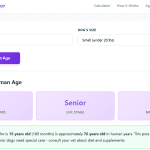
If you have ever wondered how to calculate dog age in dog years, the process is not as straightforward as multiplying by seven. In fact, modern research shows that a dog’s aging pattern changes dramatically over its lifetime. The fastest and easiest way to get an accurate number is to use a trusted online tool such as Your Age Calculator which takes into account the breed and size of your dog, giving you a more precise estimate.

Understanding why dog age calculations matter starts with recognizing that dogs of different breeds age at different speeds. Smaller breeds tend to live longer and have a slower aging curve compared to larger breeds, which age more rapidly. This means a one-size-fits-all formula is no longer considered accurate by veterinarians.
To begin, you should know your dog’s exact birth date or at least an estimation. Age conversion charts commonly break down the first two years of a dog’s life as equivalent to early adulthood in humans because during this time dogs mature quickly. After that, each year’s conversion depends on body weight and breed category.
Veterinary researchers often suggest using logarithmic equations rather than fixed multipliers. One popular approach comes from genetic studies comparing DNA methylation changes in dogs and humans across time. These formulas tend to place a one-year-old dog at about 31 human years and a seven-year-old dog closer to 62 human years, with the curve flattening for older dogs.
For a more practical home calculation, follow these steps. First, determine your dog’s age in actual years. Second, categorize your dog into small, medium, or large breed ranges. Finally, use a breed-specific conversion method or an advanced tool that applies modern veterinary science. By doing so, you will get a result that reflects your dog’s real biological stage rather than a rough estimate.
Knowing how to calculate dog age in dog years is more than a fun trivia fact. It can help you schedule vet visits more appropriately, adjust diet to match life stage needs, and detect possible age-related health risks earlier. Once you understand how the numbers work, you can better anticipate changes in your dog’s energy levels, mobility, and overall care requirements.
With accurate age conversion, your pet’s wellness plan becomes more personalized. This is one small but powerful way to help ensure your furry friend has a longer, healthier life.