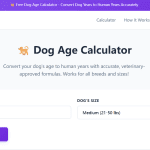
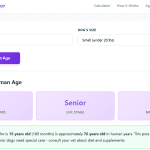
For decades, the common belief was that one dog year equals seven human years. While that makes for a simple mental shortcut, it’s far from accurate. Modern veterinary science shows that aging in dogs depends on factors like breed, size, and life stage, which means the calculation is more complex. If you want to truly understand your dog’s health and long‑term care needs, learning how to calculate dog age in human years using an evidence‑based approach is essential. This knowledge helps you anticipate potential health challenges, schedule vet visits appropriately, and adjust nutrition as your canine companion ages.

Why the “One Year Equals Seven” Rule Is Misleading
Dogs mature rapidly in their first two years, often equivalent to a human reaching their early twenties. After that, aging slows down compared to the initial rapid growth. Larger breeds tend to age faster overall, while smaller breeds often live longer and have a slower aging progression. This variation means that a one‑size‑fits‑all formula ignores critical biological differences between individual dogs.
Understanding the Modern Formula
Researchers have developed more accurate calculations based on changes in DNA methylation—essentially, a biomarker for aging. The general rule now suggested by veterinary experts for a more realistic calculation is:
Human Age ≈ 16 × ln(Dog Age in Years) + 31
While this may look technical, it accounts for the fact that dogs age quickly early in life and more gradually as they mature. ln refers to the natural logarithm, a mathematical concept that helps model non‑linear changes over time.
Step-by-Step Guide on How to Calculate Dog Age in Human Years
Find your dog’s actual age in years
Apply the modern formula or use a reliable online calculator
Consider breed and size adjustments since large breeds may require additional recalibration
Use the resulting age to plan care, diet changes, and exercise routines appropriate for the “human equivalent” stage of life
Breed and Size Considerations
Small breeds such as Chihuahuas or Toy Poodles often live beyond 15 years, with their middle age starting later than larger breeds. In contrast, giant breeds like Great Danes may be considered senior as early as age six due to faster aging. Medium breeds fall somewhere in between. Understanding these variations allows pet owners to adapt preventive healthcare and lifestyle accordingly.
Practical Benefits of Using Human Age Equivalents
Helps plan preventive vet checkups during at‑risk stages
Guides diet transitions tailored to your dog’s metabolic needs
Provides context for behavioral changes such as reduced energy or joint stiffness
Supports better long‑term quality of life by anticipating senior care needs early
Common Mistakes to Avoid
Applying the old 1:7 rule without considering breed or age stage
Ignoring signs of age‑related changes simply because the dog seems “young” chronologically
Failing to track weight and activity levels as part of healthy aging
Knowing how to calculate dog age in human years isn’t just a fun fact—it’s a practical tool for responsible pet care. By using modern science and breed‑specific understanding, you can ensure that your furry friend receives proactive attention and support at every stage of life. Whether your dog is entering the energetic adult phase or becoming a gentle senior, accurate age conversion will give you better insight into their needs and happiness.