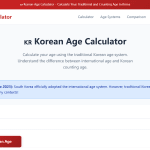
TL;DR / Summary: Korean age adds a year at birth and another every January first, so it can sit two years above international age in the first half of a year. Since 2023 the official system uses international age, but family conversation often does not, so state both when it matters.
Three systems in one family conversation
Ask a Korean family how old someone is and you may hear a number that does not match their passport, their school year, or the age on a legal form. That is not confusion. It is three counting habits overlapping.
The first is international age: completed years since birth, incremented on the birthday. The second is Korean age, which starts at one at birth and adds a year for everyone on January first. The third is year age, which simply subtracts the birth year from the current year.
Each system answers a slightly different question. International age answers “how much time has passed.” Korean age answers “which social year-group do you belong to.” Year age answers “which calendar cohort were you born into.”
What changed in the middle of 2023
In June 2023, South Korea standardised the administrative use of international age. Laws, official documents, and most forms now use the completed-years count that the rest of the world uses.
The change did not delete Korean age from daily life. People still use it in conversation, especially with family and in casual settings, because it has been the default for generations. A law change and a habit change run on different clocks.
Year age also survived in specific contexts, including school admission rules and some youth-protection statutes. That is why a single “Korean age” label can still produce three different numbers depending on who is asking.
Legal age versus everyday speech
If a form asks for age, give international age unless the form explicitly says otherwise. If a relative asks, expect the Korean number and answer in kind. Mixing the two in the same sentence is how misunderstandings start.
Converting for forms and interviews
Korean age equals the current year minus the birth year plus one. That is the whole formula. The arithmetic is easy; the trap is applying it when the year has just changed.
International age equals completed years, so it depends on whether the birthday has already passed this year. Subtract the birth year, then subtract one more if the birthday is still ahead.
Year age is the plain subtraction with no adjustment. If someone quotes an age that equals current year minus birth year, they are probably using this system, and the number will normally be one lower than Korean age.
- Form or visa: international age
- Family conversation: Korean age, unless the family has switched
- School or cohort question: year age may be the relevant one
- Medical or insurance paperwork: international age, written in full
Why a January birthday breaks the shortcut
People often remember the rule “Korean age is international age plus one” and stop there. That shortcut fails for anyone whose birthday has not yet occurred this year, because the international count has not incremented while the Korean count has.
Take a person born on December 31, 1990. On January 1, 2024, they are thirty-three internationally, having turned thirty-three the day before. Their Korean age is thirty-five: one for the birth year, plus one for the new calendar year, plus the years in between. The gap is two years, not one.
A June birthday produces the same two-year gap in January and drops to a one-year gap after the birthday. The gap is not a fixed offset; it is a seasonal difference that depends on where the date sits.
The size of the gap is a calendar question, not a personality trait.
Celebrations and the year-count habit
Korean age increments on January first for everyone, which means a shared birthday in effect. Some families mark the new year with a small acknowledgement of the new age, separate from the actual birthday later in the year.
That habit is why a person can be “thirty-five” in January and still celebrate a thirty-fourth birthday in June. Both statements are correct inside their own system, and neither is a mistake.
For children, the difference matters more. A toddler born in December can be two in Korean age while still an infant internationally, which affects how relatives talk about milestones and how daycare ratios are discussed.
Writing age so a reader cannot misread it
The simplest fix is to write the system, not just the number. “Thirty-four internationally, thirty-five by Korean age” removes every ambiguity in a single sentence, and it costs four extra words.
On documents, add the date of birth. A birth date is unambiguous in every system, and any reader can derive the age they need without guessing which convention you used.
When translating a family document for an official purpose, translate the date of birth and let the receiving office compute the age. Translating a quoted age preserves the ambiguity instead of resolving it.
For the conversion itself, Your Age Calculator takes a birth date and returns years, months, and days, which is the form most forms actually want even when they only ask for a number.
Saying your age once, clearly, in both systems
Learn the three formulas, check whether the birthday has passed, and lead with the system name when you speak. That is enough to move between a family dinner and a government office without contradicting yourself.
The 2023 change made the official answer simpler, not the social one. Treat international age as the default for anything written and Korean age as the default for anything spoken, and adjust when the other person does.
If you are ever unsure which number someone wants, give the birth date and both ages. Nobody has ever been offended by too much clarity about a birthday.